Tarp knots: clove hitch, taut-line hitch, trucker's hitch and sheet bend
Four knots finish the set you need to pitch a tarp or rig a washing line in a power cut: one fixes a line to a pole quickly, one makes guy lines adjustable, one pulls a ridge line really tight and one joins two cords of different thickness. Practise them in the garden with 10 m of 3-4 mm cord, a thicker 2 m rope, two tent pegs and a broom handle.
The short answer
- Clove hitch: quick to tie round a pole; use it to start lashings or hold a light pole.
- Taut-line hitch: slides to tighten or slacken a guy line, then holds wherever you leave it.
- Trucker's hitch: a fixed loop works like a pulley, so the ridge line tightens hard.
- Sheet bend: joins a thick rope and a thin cord.
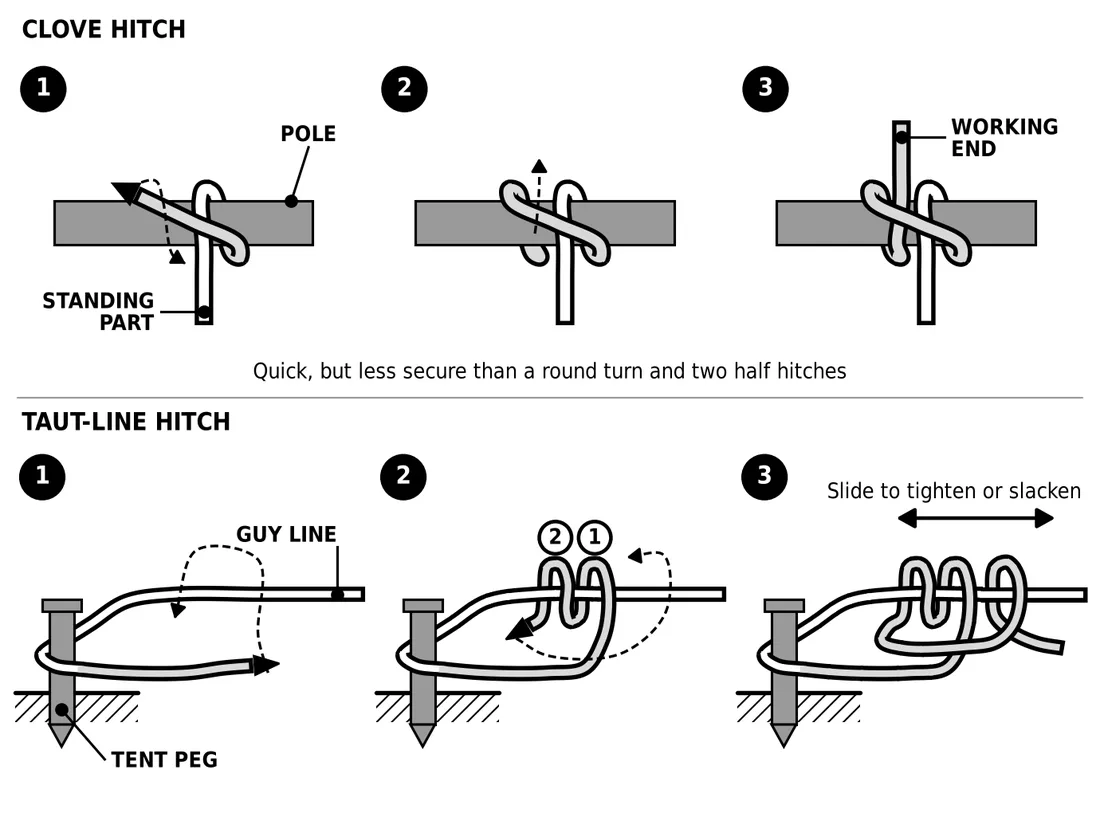
Clove hitch
- Wrap the working end round the broom handle, cross it over itself, wrap round a second time, then tuck the end under that last wrap.
- Pull tight. It is quick, but not as secure as a round turn and two half hitches, so use it to start lashings or hold a light pole.
Taut-line hitch
- Pass the cord round a peg and bring the working end back alongside the standing part.
- Wrap it twice round the standing part, working towards the peg, inside the loop.
- Bring the working end back out past those two wraps and make one more wrap round the standing part, further from the peg. Tuck it under itself.
- Slide the knot along the standing part to tighten or slacken the line; it holds wherever you leave it.
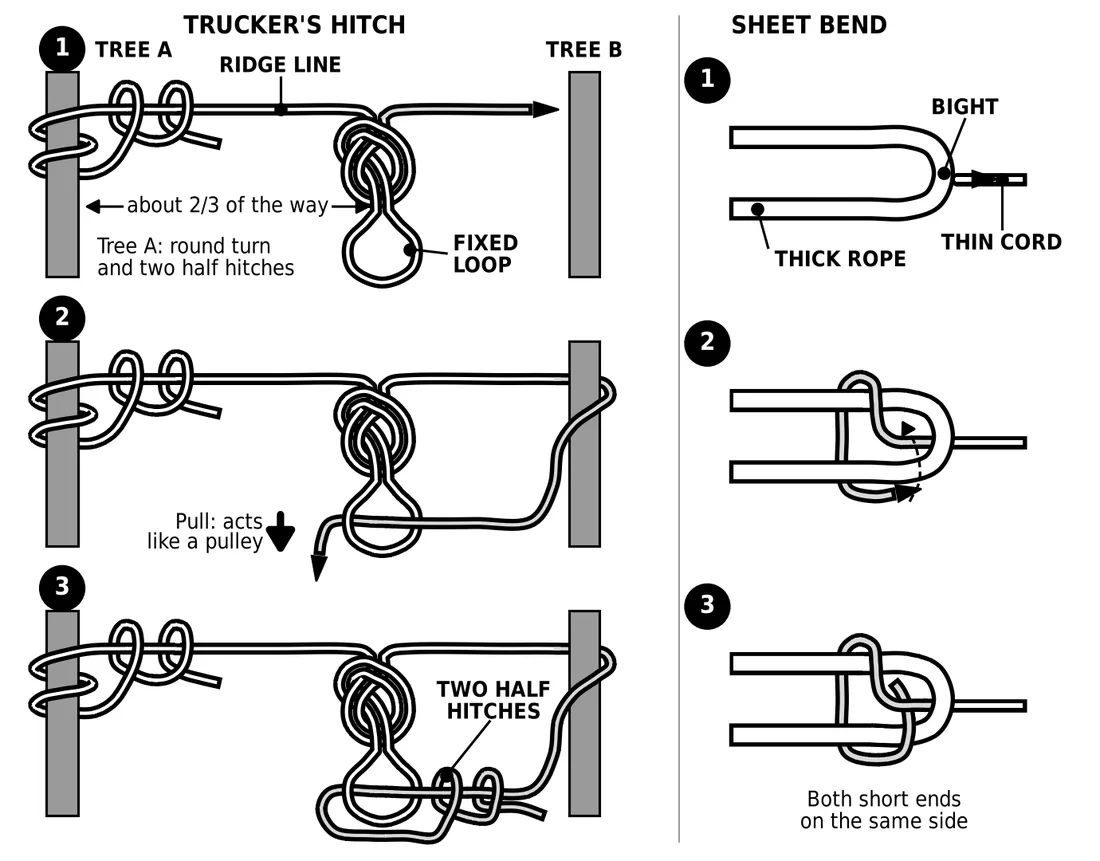
Trucker's hitch
- Tie one end of the cord to a post with a round turn and two half hitches (see the bowline guide).
- About two-thirds of the way to the second post, fold a 20 cm bight and tie a simple overhand knot with it, leaving a fist-sized fixed loop.
- Pass the working end round the second post and back through that loop. Pull it towards you: the loop acts like a pulley and the line tightens hard.
- Pinch the cord where it passes through the loop and finish with two half hitches just below it.
Sheet bend
- Make a bight in the thicker rope.
- Push the thinner cord up through the bight from underneath.
- Take it round behind both parts of the bight, then tuck it under itself, not through the bight.
- Pull tight; both short ends should finish on the same side.
Safety: cord under tension can snap back at the face. Tighten lines with your head to one side, wear gloves for the trucker's hitch, and never use a hitch tied at home to hold a person's weight.
Questions people ask
What is the difference between a taut-line hitch and a trucker's hitch?
A taut-line hitch makes a line adjustable: it slides to tighten or slacken a guy line and holds where you leave it. A trucker's hitch uses a fixed loop like a pulley to pull a ridge line very tight, then is locked with two half hitches.
Which knot joins two ropes of different thickness?
The sheet bend. Make a bight in the thicker rope, pass the thinner cord up through it, round behind both parts and tuck it under itself.
Is a clove hitch secure?
It is quick, but not as secure as a round turn and two half hitches. Use it to start lashings or hold a light pole, not for a load that matters.
How do I get a tarp ridge line tight?
Tie one end to a post with a round turn and two half hitches, put a trucker's hitch near the other post, pull it tight and lock it with two half hitches. The line should be tight enough to pluck.
Sources
Checked against these pages in November 2026. Advice and the law can change, so the official page always has the final word.