Is foraging legal in the UK? The rules in plain English
Picking blackberries for a crumble is legal in Britain. Digging up a plant, picking a protected species or collecting to sell is not. Here is the law in plain English, the simple code that keeps you on the right side of it, and the deadly lookalikes every forager must know.
The short answer
Yes, for your own use, if you pick and don't dig. In England and Wales, picking flowers, fruit or foliage from a plant growing wild is not theft unless it is for sale or other commercial purposes (Theft Act 1968, s4(3)). Uprooting any wild plant without the landowner's permission is an offence, and protected plants may not be picked at all (Wildlife and Countryside Act 1981, s13). Local byelaws and signs can ban foraging. And never eat anything you cannot identify with complete certainty.
England and Wales
- Picking is not theft: under section 4(3) of the Theft Act 1968, picking flowers, fruit or foliage from a plant growing wild is not theft, even on land you do not own, unless you do it for reward, for sale or another commercial purpose.
- Picking is not digging: under section 13 of the Wildlife and Countryside Act 1981 it is an offence to uproot any wild plant without being authorised, which in practice means without the landowner's or occupier's permission.
- Protected plants listed in Schedule 8 may not be picked, uprooted or destroyed at all. Native bluebells are protected, and digging up the plant or bulb in the countryside is prohibited.
- Local rules: nature reserves, SSSIs, National Trust land, Woodland Trust woods, parks and commons may have byelaws or signs that ban or limit foraging. Read the signs and obey them.
Scotland and Northern Ireland
In Scotland, customary picking of wild berries and fungi for your own use is not affected by the access legislation, and the Scottish Outdoor Access Code asks you to take only what you need and leave plenty for wildlife. Taking things for commercial purposes needs the landowner's permission, and it is an offence to intentionally or recklessly uproot any wild plant. Protected sites may need consent from NatureScot.
Northern Ireland has its own Wildlife Order with similar offences for uprooting wild plants and picking protected ones. Wherever you are: pick a little, never dig, never sell, and ask when you are unsure.
A simple code for every trip
- Pick for your own household only, never to sell.
- Only pick what you can identify with complete certainty.
- Take only what you will use, and leave plenty for birds and other wildlife.
- Don't trample, and never dig up roots or bulbs.
- Follow the signs: some sites ban foraging to protect rare species.
- Avoid roadsides, sprayed areas and dog-walking strips at ground level.
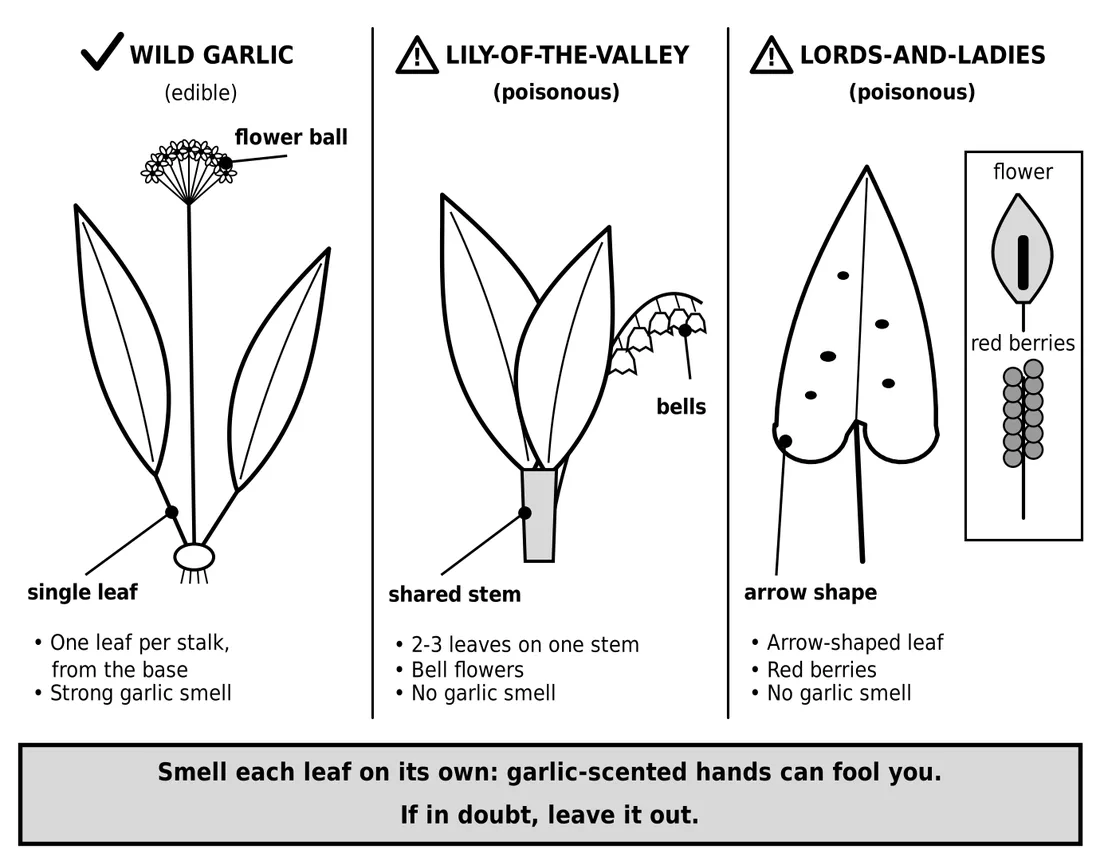
Deadly lookalikes
- Raw elderberries, elder leaves and stems are poisonous: elderberries are for cooking only.
- Lily-of-the-valley and lords-and-ladies look like wild garlic (which must smell of garlic) and sorrel.
- Hemlock and hemlock water dropwort, both deadly, resemble cow parsley.
- Foxglove leaves resemble comfrey.
- No mushrooms or other fungi unless you are taught in person by an expert: some deadly fungi look ordinary.
If you are not 100% certain, don't eat it.
Ten easy plants to learn first
| Plant | When | Notes |
|---|---|---|
| Nettle | Feb-early June | Young tips only, gloves on; cook like spinach |
| Blackberry | July-autumn | Ripe, dark, shiny fruit; away from roads |
| Elder | Flowers late May-June; berries autumn | Flowers for cordial; berries cooked only |
| Wild garlic | Spring, before flowers | Must smell of garlic; see the lookalikes above |
| Dandelion | Spring-summer | Young centre leaves, flowers |
| Hawthorn | Spring leaves; autumn berries | Young leaves; berries for jelly, sieved |
| Sloe | After first frost | Thick gloves; jelly or syrup |
| Rosehip | Autumn | Strain syrup twice through fine cloth: irritant hairs |
| Chickweed | Most of the year | Low, creeping, tiny white star flowers |
| Common sorrel | Spring | Young leaves, small amounts only |
Check every feature against a good illustrated field guide: leaf shape, stem, flower, smell, habitat. Learn one plant per trip.
Questions people ask
Is foraging legal in the UK?
Picking wild fruit, flowers and leaves for your own use is generally legal. In England and Wales it is not theft unless done for sale or other commercial purposes. Uprooting any wild plant without the landowner's permission, and picking protected plants, are offences, and local byelaws can ban foraging.
Can I dig up wild garlic or bluebells?
No. Uprooting any wild plant without the landowner's or occupier's permission is an offence, and native bluebells are protected: digging up the plant or bulb in the countryside is prohibited.
Can I sell what I forage?
Not without permission. The Theft Act exception covers picking for yourself; picking for reward, sale or other commercial purposes is not covered, and in Scotland commercial collecting needs the landowner's permission.
Is foraging legal in Scotland?
Customary picking of wild berries and fungi for your own use is not affected by the access legislation. Take only what you need, never uproot plants, and get permission for anything commercial.
Is it safe to forage mushrooms?
Not unless you are taught in person by an expert. Some deadly fungi look ordinary, and a book or website cannot teach mushroom identification safely.
Sources
Checked against these pages in November 2026. Advice and the law can change, so the official page always has the final word.
- Theft Act 1968, section 4 (legislation.gov.uk)
- Wildlife and Countryside Act 1981, section 13 (legislation.gov.uk)
- Wildlife (Northern Ireland) Order 1985, article 14 (legislation.gov.uk)
- Scottish Outdoor Access Code: guidance on foraging in Scotland
- Woodland Trust: foraging guidelines
- Woodland Trust: UK poisonous plants