How to tie a bowline knot, step by step
The bowline makes a fixed loop at the end of a rope that will not slip or tighten, which is why The Scout Association teaches it as one of the most useful knots there is. Its partner, the round turn and two half hitches, ties a rope firmly to a post, a ring or a tree: the start of every ridge line. Learn both on a chair leg in an evening.
The short answer
Make a small loop (the hole) in the standing part, bring the working end up through the hole, round behind the standing part and back down the hole, then pull the standing part tight. The rhyme: "The rabbit comes out of its hole, round the tree and down the hole again." A good bowline keeps the same size when you pull hard on the loop.
You need
- A 2 m length of soft rope, 8-10 mm thick, with taped ends
- A post, banister, chair leg or garden tree
- A ring or handle (a door handle works)
Four words first
The working end is the end you tie with. The standing part is the rest of the rope. A loop is made when the rope crosses itself; a bight is a U-bend that does not cross.
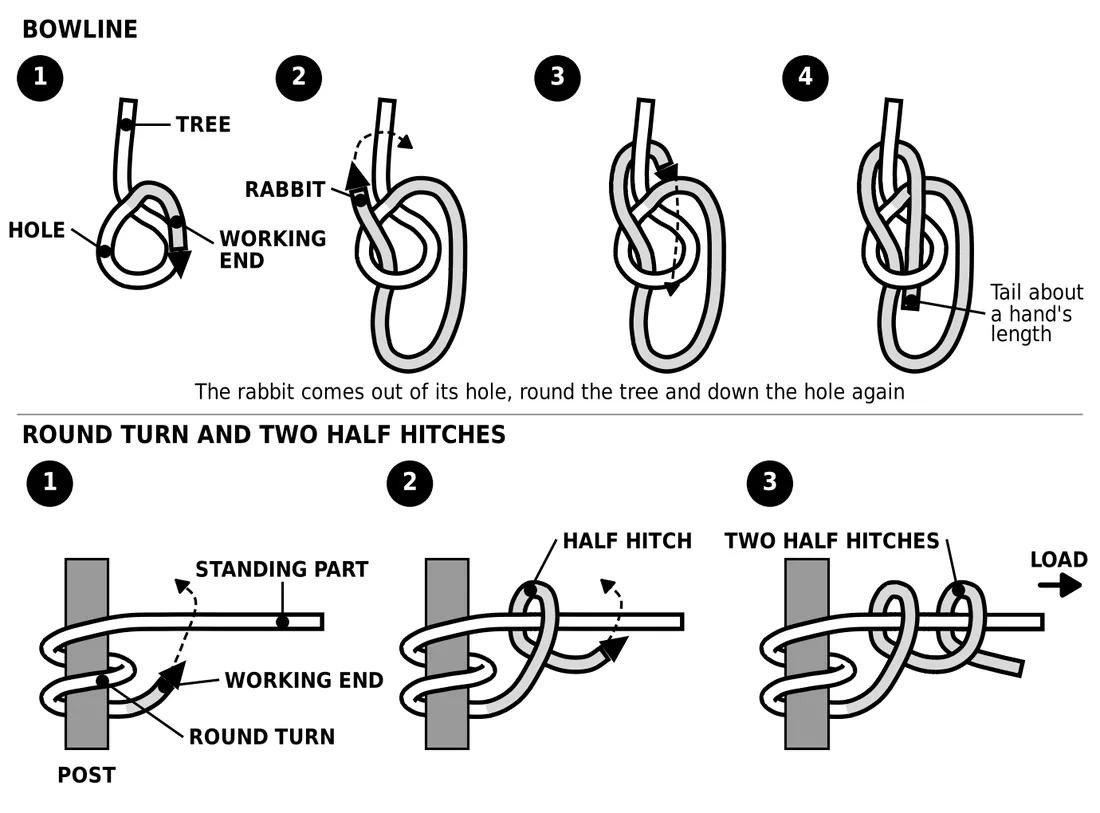
The bowline in six steps
- Learn the rhyme: "The rabbit comes out of its hole, round the tree and down the hole again." The tree is the standing part. The rabbit is the working end.
- About 50 cm from the end, make a small loop in the standing part, with the part running to the working end lying on top. This is the hole.
- Bring the working end (the rabbit) up through the hole from underneath. The bigger loop below is the one you are making, so size it now.
- Take the rabbit round behind the standing part (the tree).
- Bring it back down through the hole beside itself. Hold the rabbit and the side of the big loop together and pull the standing part firmly. Leave a tail about as long as your hand.
- Check it: pull hard on the big loop. It should stay the same size.
Round turn and two half hitches
Use it to tie a rope firmly to a post, a ring or a tree.
- Pass the working end round the post twice, so it wraps fully round. This takes the strain while you finish.
- First half hitch: bring the end over the standing part, round it and back through the gap you made.
- Second half hitch: repeat exactly the same way, a little further along. Slide both hitches snug up to the post.
Practise until it is automatic
- Tie each knot three times with your eyes open, then once with your eyes closed. You know it when you can tie it in under ten seconds.
- Aim to tie a bowline round your own waist with your eyes shut, as Scouts are encouraged to.
- Put red tape on the working end and blue on the standing end: children then always know which end is the rabbit.
- Readers of the book can log every knot on the knot practice cards in the planner.
Safety: these knots are for tying things, not for holding people off the ground. Climbing, abseiling and rescue lifting need proper training and equipment. A bowline cannot be tied or untied while the rope is under load, so tie it before the strain comes on.
Questions people ask
What is a bowline knot used for?
To make a fixed loop at the end of a rope that will not slip or tighten: round a post or tree, to hang a line, or to secure a load. It stays the same size when you pull on it.
What is the rhyme for tying a bowline?
"The rabbit comes out of its hole, round the tree and down the hole again." The hole is a small loop in the rope, the tree is the standing part and the rabbit is the working end.
Can you tie or untie a bowline under load?
No. A bowline cannot be tied or untied while the rope is under load, so tie it before the strain comes on.
Is a bowline safe for climbing or lifting a person?
Not with a rope tied at home. Climbing, abseiling and rescue lifting need proper training and equipment. Use these knots for tying things, not for holding people off the ground.
How do I tie a rope to a post or tree?
Use a round turn and two half hitches: wrap the rope round the post twice, then tie two half hitches round the standing part and slide them snug up to the post.
Sources
Checked against these pages in November 2026. Advice and the law can change, so the official page always has the final word.